How to Spot Online Job Scams in 2026 (WhatsApp and Telegram Task Scams)
Learn how fake "work from home" and task jobs really work, the warning signs to look for, and what to do if you have already been targeted.
Published: October 10, 2026 · Updated: November 14, 2026 · By Ghulam Mustafa Janjua, Dubai
If you are looking for online work, you have probably received a message like this: "Hello, we are hiring part-time staff. Earn 500 to 2,000 per day from your phone. Only 30 minutes needed." It often arrives on WhatsApp or Telegram, from a number you do not know.
These messages are one of the most common online scams in 2026, in the UAE, Pakistan, India and around the world. Many victims are students, job seekers and people looking for side income. This guide explains exactly how these scams work, so you can recognise them in seconds.
A real job pays you. If any "job" asks you to send money first, for a fee, a deposit, an upgrade or to "unlock" your earnings, it is a scam. Stop immediately.
How the Task Scam Works, Step by Step
Most WhatsApp and Telegram job scams follow the same pattern. Knowing the steps makes them easy to spot.
- The friendly first message. Someone contacts you claiming to be a recruiter for a well-known company, an online shop or a marketing agency. They offer easy part-time work.
- Simple "tasks". You are asked to like YouTube videos, follow social media accounts, rate hotels or products, or leave reviews.
- Small real payments. To build trust, they actually pay you a small amount for the first few tasks. This is the hook.
- The group chat. You are added to a Telegram group where other "members" post screenshots of big earnings. Many of these members are fake accounts controlled by the scammers.
- The "prepaid" or "VIP" task. You are told that bigger tasks require you to deposit money first, with the promise of getting it back plus a large commission.
- The trap. Your balance on their website looks like it is growing, but you cannot withdraw. Each time, they ask for another payment: a "tax", a "fee", or a deposit to "fix an error".
- They disappear. Once you stop paying, your account is blocked and the group is gone, along with your money.
10 Warning Signs of an Online Job Scam
- You receive a job offer you never applied for
- The salary is very high for very little work
- No interview, no contract and no real company email
- Everything happens only on WhatsApp or Telegram
- The "tasks" are liking videos, rating hotels or writing reviews
- You are asked to pay a registration, training or deposit fee
- You are asked to pay in cryptocurrency or to an unknown person
- You are pressured to act fast: "limited spots", "today only"
- Your earnings show on a website but you cannot withdraw them
- They ask for your OTP code, bank login or a photo of your ID
My Real Test: Can a Free AI Tool Spot a Job Scam?
Many people now ask AI tools for help before they reply to a job offer, so I wanted to see if this really works. I wrote an example message myself, using the same pattern as the task scam above. It is not a message I received, and it does not use any real company's name. On 14 November 2026 I pasted it into the free plan of ChatGPT and asked: "Is this job message a scam? Answer in simple words and list the warning signs."
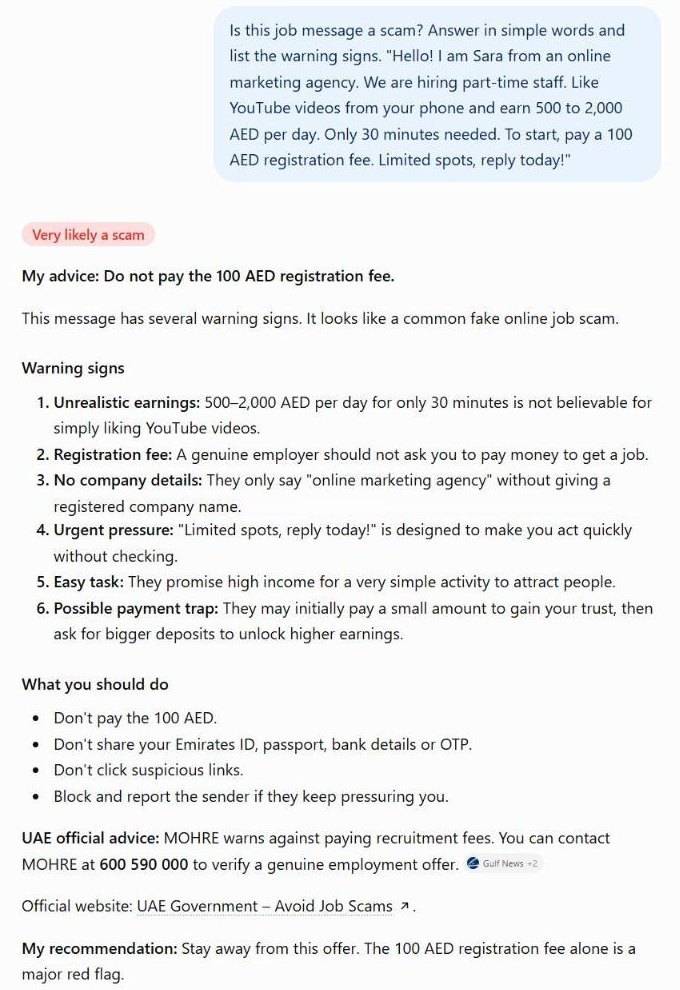
Then I checked the answer myself:
- The verdict was right. The six warning signs it listed match the warning signs and the scam steps explained above, and it told me not to pay the 100 AED.
- The phone number was correct. It gave the MOHRE number 600 590 000. I checked it, and the same call centre number appears in Khaleej Times and Gulf News reports from August 2026 about MOHRE's warning on fake job offers.
- It missed one useful check. Those same reports say a genuine UAE job offer uses the MOHRE-approved offer form with a serial number or barcode, which you can verify. ChatGPT did not mention this.
- It said "very likely", not "100%". AI is a helper, not a final judge. The safe step is still to check the company yourself through its official website.
My lesson: a free AI tool can be a good second opinion before you reply to a suspicious message. But remove your own name, phone number and other personal details before you paste a message into any AI tool, and never send money just because a chat or an AI said it looks fine.
Other Common Online Job Scams
Fake recruiter and visa scams
Someone offers a job abroad or in the UAE but asks for money for a visa, medical test or "processing". Real employers follow official hiring processes, and you should never pay a stranger for a job offer.
Fake freelance clients
On Fiverr or Upwork, a "client" asks you to move the chat to WhatsApp or Telegram, or to pay for software or a "test" before starting. Keep all communication and payments on the platform, where you are protected.
Fake check or overpayment scams
A "client" sends you more money than agreed and asks you to return the difference. Later, the original payment is reversed and you lose the money you sent back.
Paid "earn online" courses and apps
Some apps and courses promise guaranteed daily income if you buy a package. If the main way to earn is by paying or inviting other people, it is not a real job.
What Real Online Work Looks Like
Legitimate online income is slower, but it is real. You offer a skill such as design, video editing, writing or tutoring, and clients pay you for finished work. You never pay to get a job.
- How to Earn Money on Fiverr with AI
- How to Earn Money Online in the UAE with AI
- How to Earn Money Online in Pakistan with AI
What to Do If You Have Been Scammed
- Stop paying immediately. Scammers will always ask for "one last payment". Do not send more money to recover what you lost.
- Contact your bank right away. Tell them it is fraud. Acting quickly gives the best chance to block or trace payments.
- Save evidence. Take screenshots of chats, phone numbers, website addresses and payment receipts.
- Report it. In the UAE, you can report online fraud through the police, including Dubai Police's official eCrime platform (ecrime.ae). In Pakistan, report cybercrime to the National Cyber Crime Investigation Agency (NCCIA). In other countries, contact your local police or cybercrime authority.
- Report and block the accounts in WhatsApp or Telegram so they cannot target others.
- Beware of "recovery" scams. Anyone who contacts you offering to get your money back for a fee is usually another scammer.
Being scammed is not something to feel ashamed of. These groups are organised and use clever tricks. Reporting helps protect other people.
Simple Safety Habits
- Never share OTP codes, passwords or bank details
- Check a company's official website and contact it directly
- Search the company name plus the word "scam" before replying
- Turn on two-step verification in WhatsApp
- Talk to a friend or family member before sending any money
Frequently Asked Questions
Are paid "like and subscribe" jobs real?
No. Being paid to like videos or rate hotels is a common scam pattern. Small first payments are used to build trust before asking you to deposit money.
Can I get my money back from a task scam?
Sometimes, especially if you contact your bank and report it quickly. Recovery is not guaranteed, so act fast and never pay anyone who promises to recover your money for a fee.
Why did they pay me at the start?
The first small payments are bait. They make the job feel real so that you trust them with larger deposits later.
Is every job offer on WhatsApp a scam?
Not every one, but unexpected job offers from unknown numbers are very often scams. A real employer will have an official website, company email and a proper hiring process, and will never ask you to pay.
What is the safest way to earn money online?
Learn a skill that people pay for, such as design, video editing or writing, and offer it through trusted platforms like Fiverr and Upwork or directly to local businesses.
Final Advice
If an online job sounds too easy, pays too much, or asks you for money, walk away. Real online income comes from useful skills and patience, not from tasks that anyone can do in 30 minutes. Share this guide with friends and family. One message can save someone from losing their savings.
Note: This article is for general awareness only and is not legal advice. For help with a specific case, contact your bank and local authorities.
Start Earning the Real Way
Seven realistic ways for beginners to earn online with free AI tools.
7 Ways to Earn Money with AI